Fiscal cliff deal alters tax landscape
You can take action to minimize the deal’s impact
The deal reached on January 1, 2013, to temporarily avoid the so-called fiscal cliff means most Americans will experience an increase in taxes. Here are some reasons why, and some ways you may be able to limit the impact the new tax code will have on you.
Payroll tax holiday ends in 2013.
The break that American wage earners enjoyed in 2011
and 2012 on FICA and Medicare withholdings has ended,
meaning a 2% hit to your paycheck. Over the last two years,
many Americans have gotten used to the extra take-home pay
– now is the time to adjust spending and saving so you don’t
feel the crunch of the reinstated tax.
Medicare surcharge. In 2013, there is a new 3.8% Medicare
surcharge on investment income over $200,000 for individuals
and $250,000 for married couples filing jointly. One way to avoid
the full impact of the surcharge is by converting assets in your
traditional IRA to a Roth IRA to enjoy tax-free benefits when it’s
time to withdraw.
Most Bush-era tax cuts made permanent. But only for individuals
making less than $400,000 and families making under $450,000 filing
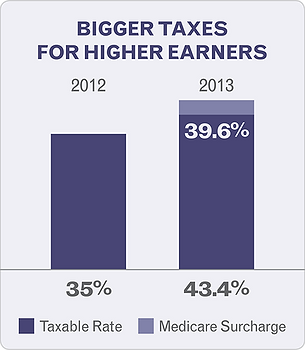
jointly. Income above those levels will be taxed at 39.6%, which
becomes 43.4% with the Medicare surcharge, up from
35%. High-income earners may want to consider starting or
increasing a salary deferral into a traditional non-qualified deferred
compensation plan or an employer-sponsored non-qualified deferred
compensation plan like a mirror 401(k).
Capital gains maximum rate going up. Long-term capital gains will have a maximum tax rate of 20% (up from 15% in 2012) or 23.8% with the Medicare surcharge. Investors will need to decide if they really need to harvest their gains in 2013, or hold on to their assets to see if the tax rates go lower in the future. If you must take gains for investment purposes, be sure to use any losses to offset the tax.
The debates in Washington go on, and experts say the ongoing congressional deal-making and subsequent market volatility could still meaningfully impact your retirement portfolio. Talk to your financial advisor and your tax advisor to learn more about your investment and tax strategy options.
Unless certain criteria are met, Roth IRA owners must be 59½ or older and have held the IRA for five years before tax-free withdrawals are permitted. Additionally, each converted amount is subject to its own five-year holding period. Investors should consult a tax advisor before deciding to do a conversion.
The information contained herein has been obtained from sources considered reliable, but we do not guarantee that the foregoing material is accurate or complete.
Investing involves risk and investors may incur a profit or loss.
Material prepared by Raymond James for use by its financial advisors.